Focused Investigations Across Public Records
FOIA Lab conducts structured research across multiple domains where fragmented disclosures, technical programs, and cross-agency activity intersect.
Our research areas are not defined by assumptions—
they are defined by where patterns are most likely to emerge.
Advanced Research Programs
We analyze publicly disclosed research initiatives that explore emerging technologies, particularly those involving:
- Human–machine interaction
- Cognitive and neurological interfaces
- Signal processing and behavioral analysis
- Bio-signature identification and tracking
Programs associated with entities such as:
- DARPA
- IARPA
are reviewed for:
- Technical capabilities
- Stated objectives vs. implied applications
- Continuity across program phases
The focus is not on individual programs—but on how they evolve and connect over time.
Signals Intelligence and Data Processing
We examine disclosures related to large-scale data collection, processing, and analysis systems.
This includes areas such as:
- Signal interception and interpretation
- Pattern recognition systems
- Behavioral and predictive analytics
- Data fusion across multiple inputs
Relevant agencies include:
- NSA
- DIA
- ODNI
Our objective is to understand how capabilities are described, limited, or abstracted in public records.
Geospatial and Surveillance Systems
Public records often reference systems involved in observation, tracking, and environmental sensing.
We analyze:
- Satellite-based collection systems
- Geospatial intelligence frameworks
- Long-range sensing technologies
- Persistent monitoring architectures
Associated entities include:
- NGA
- NRO
The focus is on identifying how these systems contribute to broader data ecosystems.
Cyber and Operational Infrastructure
We review records related to operational environments where data is deployed, tested, or utilized.
This includes:
- Cyber operations frameworks
- Command and control structures
- Integration of intelligence outputs into operations
- Testing and deployment environments
Relevant organizations include:
- USCYBERCOM
- Military branches and associated research units
Our goal is to understand how capabilities move from research into operational contexts.
Cross-Agency Coordination
Many capabilities cannot be fully understood within a single agency.
FOIA Lab prioritizes analysis of:
- Shared terminology across agencies
- Overlapping program timelines
- Inter-agency references within documents
- Consistent structures in FOIA responses
This area is critical for identifying whether independent disclosures point to coordinated systems.
FOIA Response Structures and Redaction Patterns
Public records are shaped not only by what is released—but how they are released.
We study:
- Redaction consistency across agencies
- Use of exemptions and denial language
- Structural similarities in responses
- Gaps, omissions, and partial disclosures
These patterns can reveal as much as the underlying content.
Temporal Analysis and Program Evolution
Understanding when something appears is as important as what appears.
We track:
- Program timelines
- Shifts in terminology over time
- Transitions between research phases
- Emergence and disappearance of capabilities
This allows us to identify continuity that may not be explicitly stated.
Application to Ongoing Investigations
These research areas are not theoretical.
They are actively applied to ongoing investigations involving:
- Advanced research programs
- Intelligence and surveillance capabilities
- Cross-agency activity over extended timelines
The purpose is to determine whether independent disclosures, when combined, form consistent and verifiable patterns.
How These Areas Work Together
Each research area provides a partial view.
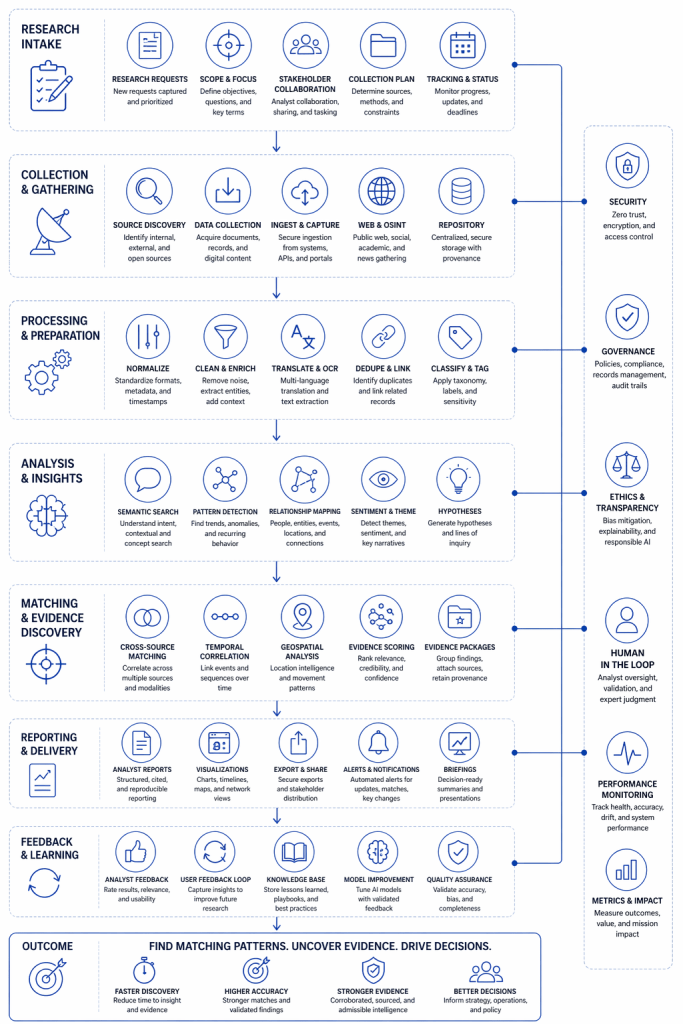
Combined, they form a structured investigative model:
- Research programs define capabilities
- Intelligence systems process data
- Surveillance systems collect inputs
- Operational environments apply outputs
- FOIA responses shape what is visible
By analyzing all layers together, FOIA Lab moves from isolated records to integrated understanding.
The Objective
The goal of these research areas is not to confirm a narrative.
It is to answer a more important question:
Do the patterns within public records support the existence of coordinated capabilities beyond what is explicitly disclosed?
 FOIA Lab